
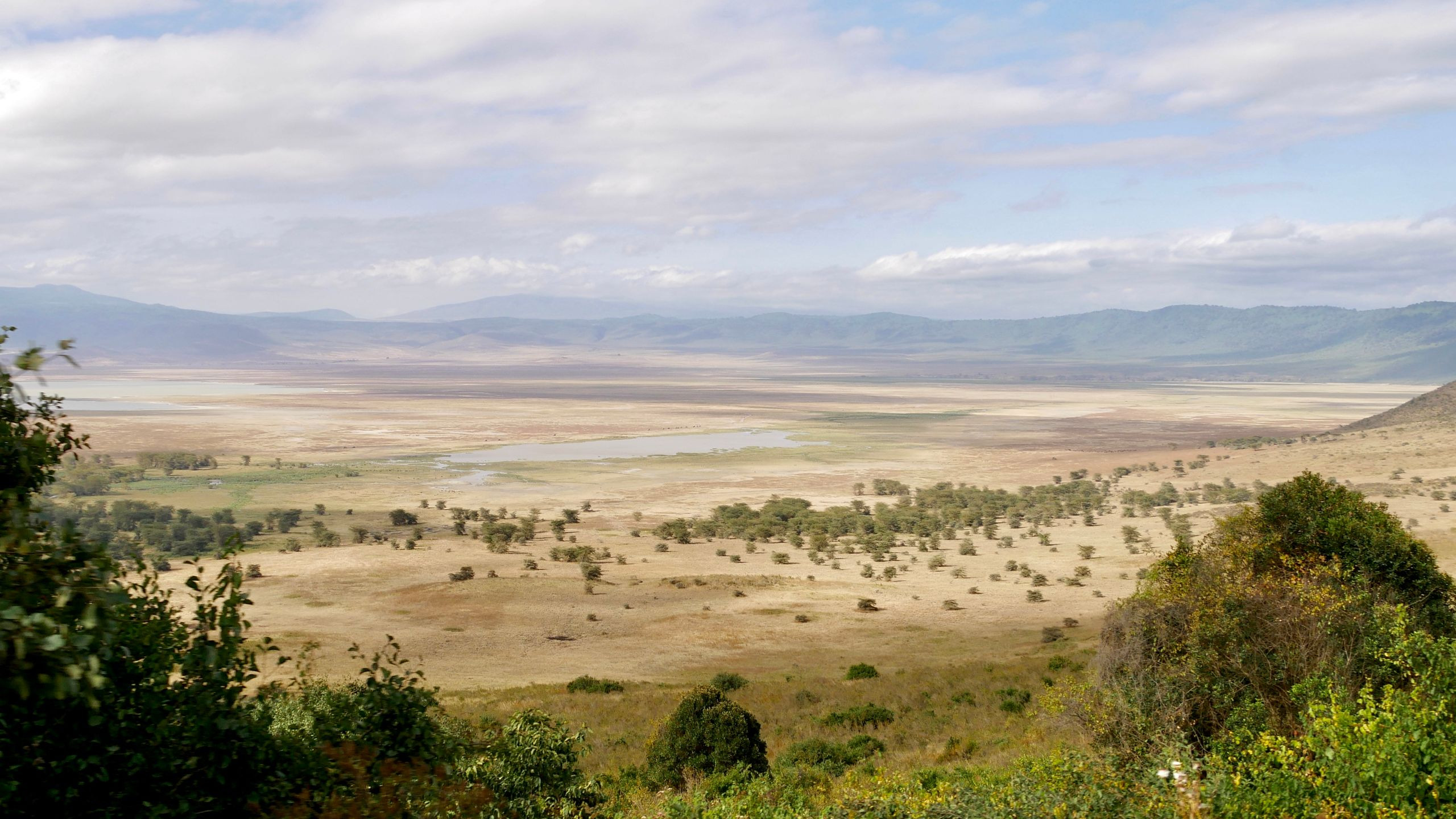
Ngorongoro Crater
A collapsed volcanic caldera in northern Tanzania holding one of the densest concentrations of large mammals anywhere in Africa, including black rhino.
- Country
- Tanzania
- Best time
- Year-round; June to October offers the driest, clearest game viewing
- Safaris here
- —
- Places to stay
- —
A collapsed volcanic caldera in northern Tanzania holding one of the densest concentrations of large mammals anywhere in Africa, including black rhino.
Roughly three million years ago, a volcano larger than Kilimanjaro collapsed in on itself, leaving behind a caldera so vast that its floor now holds a self-contained ecosystem — grassland, soda lake, forest and swamp all within a single unbroken wall some 600 metres high. That wall does more than frame a dramatic view: it also keeps much of the resident wildlife inside, which is why the crater floor supports one of the highest densities of large mammals found anywhere on the continent.
A day spent descending into the crater tends to deliver an unusually complete cast of characters in a short space of time — lion prides that rarely leave the caldera, one of Tanzania’s last strongholds of the endangered black rhino, dense herds of wildebeest and zebra, and flamingos gathered along Lake Magadi’s shallow, mineral-rich shoreline. Because the crater floor is compact relative to its wildlife numbers, game drives here move at a different pace than on the open Serengeti plains — less searching, more watching.
Most visits to the crater are built around an overnight stay on the rim, where lodges look straight down into the caldera, followed by an early descent before the day’s heat sends much of the wildlife into shade. It pairs naturally with the Serengeti as part of Tanzania’s northern circuit, usually as either the opening or closing leg of a longer safari.
- Extremely high wildlife density on a compact crater floor
- One of Tanzania's last strongholds of black rhino
- Lake Magadi's flamingo-lined shoreline
- Dramatic rim-top lodges overlooking the caldera
- Easy pairing with the Serengeti on Tanzania's northern circuit
By Road
Around 2 hours from Arusha, usually combined with onward travel to the Serengeti as part of a northern-circuit safari.
By Air
Charter flights connect Arusha to a nearby airstrip for travellers on a fly-in itinerary.
- Kenya-registered tour operator
- Tailor-made, never off-the-shelf
- Local guides, fair wages
- Replies within one working day